
Antarctica Fly and Cruise

Skip the Drake Passage. Maximise your time in Antarctica.
Two hours by air replaces two days at sea. The Drake Passage becomes a view from the window, not a crossing. And what you save in ocean time, you spend where it matters, at 36-guest scale, on the Peninsula, in the ice.
A Secret Atlas Antarctica fly and cruise voyage is built around three things: 36 guests on the whole ship, all ashore in a single Zodiac deployment, and a gateway hotel in Puerto Natales, at the foot of Torres del Paine, rather than another airport city. The operational flight window is deliberately wider than industry standard, giving our team more room to hold the schedule when Antarctic weather does what it does.
Thirty-six guests on the whole ship. All ashore in one Zodiac deployment. A gateway hotel in Puerto Natales, at the foot of Torres del Paine, rather than another airport city. And an operational flight window built to hold the schedule when Antarctic weather does what it does.
Why choose a Secret Atlas Antarctica Fly Cruise?
Just 36 guests – Our Expedition Micro Cruise ships are among the smallest in Antarctica. Everyone lands together. No waiting, no rotations, no missing out.
A two-hour flight instead of a two-day crossing – By skipping the Drake Passage, you gain up to four extra days in Antarctica compared to sail-only voyages.
Fly from Puerto Natales, not Punta Arenas – Immerse yourself in Patagonia’s fjords and mountains from day one instead of waiting in a city hotel.
45% longer flight window – We extend operations beyond other operators, giving you the highest chance of reaching Antarctica.
Slow luxury experience – Boutique lodges, authentic Patagonian cuisine, and carefully curated excursions create a seamless journey from Patagonia to Antarctica.

Are you ready for a transformative experience on our Antarctica Fly Cruise?
How does a Fly and Cruise to Antarctica work?
The best fly and cruise to Antarctica balances efficiency with authentic experiences at every stage. We've perfected this journey to ensure you spend more time where it matters most – on the White Continent itself.
Day 1 to 2: Puerto Natales and the Chilean fjords
Your Antarctic journey begins in one of Patagonia's most charming towns, where dramatic fjords and snow-capped peaks create the perfect prelude to polar exploration. Puerto Natales isn't just a departure point – it's your gateway to understanding Patagonia's wild spirit.
You'll stay at our carefully selected boutique Weskar Lodge, that captures the essence of slow luxury travel. Think gourmet dining featuring local lamb, craft breweries, and cosy common areas where fellow travellers share stories. The town's intimate scale means everything feels personal and exclusive, far removed from the hustle of larger cities.
While awaiting your weather window, you're not simply waiting. You're exploring Torres del Paine's doorstep, experiencing authentic gaucho culture, and allowing yourself to transition naturally from everyday life to Antarctic adventure.


Day 3: Private charter flight to King George Island
When Antarctic weather conditions align, you'll board your private charter for the two-hour journey to King George Island. There's something magical about watching the landscape below transform from Patagonian steppes to the endless white of Antarctica.
These aren't scheduled commercial flights – they're exclusive charters that operate only alongside organised Antarctic expeditions. The flight itself becomes part of your adventure, offering aerial views of the Southern Ocean and your first glimpse of the continent that few humans ever experience.
Upon landing, you'll transfer directly to your expedition vessel via zodiac, with King George Island's research stations and penguin colonies providing your first taste of Antarctic life.
Day 4 to 8: The Antarctic Peninsula
The heart of the voyage. The expedition team draws on landing options across the Antarctic Peninsula and the surrounding islands, matching the day's ice and weather to the sites that will work. Depending on conditions and season, the routing may include:
Neko Harbour, a continental landing on the Antarctic mainland, with a gentoo colony and glacier views
Cuverville Island, one of the largest gentoo penguin colonies on the Peninsula (around 4,800 breeding pairs)
Danco Island, a dome-shaped landing with a summit walk to panoramic views across the Errera Channel
Wilhelmina Bay, some of the strongest humpback whale feeding in the region during January and February
Paradise Harbour, sheltered water for Zodiac cruising among tabular icebergs
Port Lockroy and Goudier Island, the historic British base and the working penguin post office
Deception Island, a flooded volcanic caldera with the ruins of the Whalers Bay whaling station
Cierva Cove, a Zodiac-cruise destination with a calving glacier face and dense wildlife
Two Zodiac operations or shore landings a day, when the conditions allow. Between them, lectures in the lounge, meals at flexible times, and open bridge access whenever the captain has the wheel. The polar plunge and Antarctic camping are available on selected departures.

The Expedition Micro Cruise concept


The Expedition Micro Cruise difference
Every fly and cruise operator sells "small group," "expert guides," and "flexibility." At the specific level of scale that changes the day, only a handful actually deliver it. Here is what changes at 36 guests, in concrete terms.
One landing, not four rotations
At 100 guests, IAATO rules force a rotation of small groups ashore, one at a time. At 36 guests, the whole ship lands together in a single Zodiac deployment. The time you spend at the colony, on the beach, or on the hike is time not lost to logistics.
Six guests per Zodiac, one polar guide driving
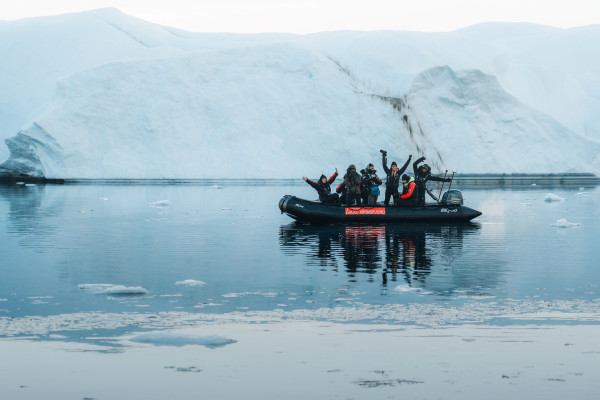
Standard practice in the industry is 10 to 12 guests per Zodiac. Our Zodiacs run at six guests each in Antarctic waters, with one polar guide on the tiller who is also a naturalist. Every guest has a window seat. Every guest is within speaking distance of the guide. The guide knows every guest by name.
Five expedition guides on every voyage, with a 1:7 ratio
Our Antarctic fly and cruise voyages run with a full expedition team of five polar guides for 36 guests, a 1:7 ratio, well below the typical 1:9 to 1:11 offered by larger operators. The team includes working naturalists, geologists, ornithologists, and former expedition leaders. On board, you might sail with expedition leaders like Robert Gilmore, whose polar career began at McMurdo Station in 1996 and has taken him back to Antarctica across nearly three decades. Guides are assigned by season, and we can share the specific team for any given departure.
Aureum, purpose-refit for the polar world
Our Antarctic vessel, MV Aureum is ice-strengthened, low-emission, and quiet enough to hold position at a whale sighting without disturbing the encounter. Ensuite cabins on every deck. A panoramic lounge, open bridge, on-deck sauna and hot tub. Capable in the conditions, comfortable when the day is done. The ship is upcycled rather than newly built, which is a structural sustainability decision: the refit avoided the embodied carbon of new construction, and the modern Tier III engine with NOx filter reduces emissions and vibration on the water.
Fly or Sail
The beauty of our approach lies in flexibility. Some guests choose to fly both ways, maximising their time on the continent whilst minimising travel days. Others prefer our blend experiences – flying one direction and sailing the other to experience both the efficiency of flight and the traditional adventure of crossing the Drake Passage.
Each option offers unique perspectives. Flying provides that incredible aerial view and swift arrival, whilst sailing lets you experience the gradual transition from civilisation to wilderness that Antarctic explorers have known for generations.

Flight contingency: what happens if weather delays the flight
Charter flights to Antarctica operate in one of the most weather-dependent environments on Earth. Our commitment is simple: to take you to Antarctica. Throughout any delay, we continue looking after you with accommodation, meals, and expedition team support at Weskar Lodge.
Short delays (standby at the lodge)
Guests remain on standby while our team monitors the weather window. Access to the wellness area, club house, and Puerto Natales continues as normal.
Overnight postponement
If the flight is confirmed postponed to the next day, we offer complimentary local experiences alongside continued accommodation and meals.
Extended delay (96+ hours outbound)
If the outbound flight has not departed within 96 hours of schedule, guests may choose to continue on a revised expedition where feasible, or conclude their participation and receive the remedies set out in the Fly and Cruise Annex to the Expedition Participation Contract.
Return flight delays
The return flight operates as soon as conditions permit. If the return is prevented for an extended period, we may return you to South America by expedition vessel and continue managing your onward travel to Puerto Natales.
Full documentation is provided throughout to support any travel insurance claim.

Antarctica cruises

South Georgia and Antarctica Shackleton Special Expedition Micro Cruise
54°16’S, 36°30’W
19 days. South Georgia, Elephant Island, and Antarctica in a single voyage. The three places that define the Endurance expedition, followed in sequence. 36 guests aboard Aureum. Spring breathes new life as South Georgia’s vast king penguin colonies teem with activity. Fur seal pups begin to appear, while wandering albatross soar effortlessly overhead.
- 36 guests
- 19 days

Antarctic Peninsula Expedition Micro Cruise by Air & Sea
54°16’S, 36°30’W
Sail the Drake Passage south from Ushuaia, then fly out of Antarctica direct to Patagonia. Four full days on the Peninsula, 36 guests, six senior polar guides, and a farewell night beneath Torres del Paine. The crossing is the point. The flight is the exit.
- 36 guests
- 9 days

Antarctic Circle Expedition Micro Cruise by Air
54°16’S, 36°30’W
Charter flight from Patagonia. Seven full days in Antarctica. A push for the Antarctic Circle at 66°33'S on every departure. Explore pristine ice, wildlife-rich bays, and iconic sites without crowds, and free from rigid schedules with only 36 guests, the first ship of this size in Antarctica.
- 36 guests
- 11 days

Antarctic Circle Christmas Expedition Micro Cruise by Air
54°16’S, 36°30’W
Christmas Day on the Antarctic Peninsula, in perpetual summer light. A charter flight from Puerto Natales, seven full days on the ice, and a push for the Antarctic Circle at 66°33'S.
- 36 guests
- 11 days

Antarctic Circle New Year Expedition Micro Cruise by Air
54°16’S, 36°30’W
Welcome the New Year in Antarctica on a 36-guest Fly & Cruise expedition. New Year's Eve on the Antarctic Peninsula, in light that does not fade. Charter flight from Puerto Natales, seven full days on the ice, a push for the Antarctic Circle at 66°33'S.
- 36 guests
- 11 days

Falklands, South Georgia and Antarctica Micro Cruise
Combine Falklands, South Georgia and Antarctica on a 78-guest cruise expedition in Spring. Follow in Shackleton’s footsteps, witness penguin chicks and whales, and enjoy uncrowded, pristine landscapes.
- 78 guests
- 21 days
When to go: Antarctica fly and cruise by season
Antarctica fly & cruise expeditions run during the austral spring to autumn, from November through March. Each month brings unique conditions, wildlife encounters, and photographic opportunities.
November – pristine beginnings
The season opens with freshly fallen snow, sculpted icebergs, and untouched landscapes. Penguins begin their courtship rituals, and the continent feels wild and undiscovered. With fewer visitors, November is perfect for travellers seeking solitude and dramatic photography.


December & January – peak wildlife and endless light
This is the heart of the Antarctic summer. Around Christmas, penguin chicks start hatching, and whales are increasingly active. Nearly 24 hours of daylight means long days of exploration, soft evening light, and unbeatable conditions for photographers.
February & March – whales and changing light
As summer transitions to autumn, penguin chicks fledge, and whale sightings peak. The light shifts to spectacular sunsets and rich colours, creating dramatic backdrops for wildlife and landscape photography. These shoulder months are often favoured by photographers for their atmosphere and contrast.

When is the best time to fly to Antarctica?
The best time depends on what you want to experience:
November: pristine snowscapes, fewer visitors
December–January: peak wildlife, endless daylight
February–March: whales, rich sunsets, powerful photography
No matter when you choose, flying to Antarctica ensures you’ll maximise your time on the White Continent, skipping the Drake Passage and arriving ready to explore.
Antarctica fly and cruise vs sail-only vs sail-and-fly
There is no single right answer. All three routes reach the same Peninsula, work the same landing sites, and use the same expedition standards. The choice comes down to how much time you have, how you feel about the Drake Passage, and what you want the shape of the voyage to be.
Choose fly and cruise if:
Time is your constraint. You want maximum time on the Peninsula, minimum time in transit.
The Drake Passage is a concern. For reasons of seasickness, mobility, or preference.
You can absorb a weather delay. Fly-cruise voyages carry a small risk of flight-schedule shifts. Our wider flight window minimises this, but the risk is not zero.
You want the Patagonian gateway. Puerto Natales and Torres del Paine are part of the trip, not a transit stop.
Choose sail-and-fly (sail in, fly out) if:
You want the Drake Passage experience once, not twice. Sail south for the crossing, the albatross, and the arrival by sea. Fly north to save two days on the return.
You want the middle path. More time on the Peninsula than a full sail-only voyage, more sea-crossing experience than a full fly-cruise voyage.
You have a specific reason to fly one direction. Return-flight commitments, a tighter schedule at the end of the trip, or lower tolerance for a second crossing after the polar leg.
Choose sail-only if:
The Drake Passage is part of the appeal. For many polar travellers, crossing the Drake is a rite of passage.
You want the maximum wildlife time at sea. Southern Ocean crossings deliver strong albatross, petrel, and whale sightings between ports.
You prefer a lower total cost. Fly and cruise voyages carry the additional cost of the charter flights.
Antarctica Fly and Cruise FAQs
What happens if my flight is delayed?
Antarctic weather dictates all flight operations, so flexibility remains essential for any polar expedition. If your outbound flight from Puerto Natales faces delays, you'll remain at our carefully selected lodges with full board and curated soft-adventure experiences until conditions allow departure.
We've extended our operational windows significantly beyond other operators – whilst most set cut-offs on Day 4 afternoon, ours extends to Day 5 evening. This increases your flight chances by over 45%. Even in worst-case scenarios, you'll still enjoy a minimum of three full Antarctic days.
For return flights, if weather delays your departure from King George Island, you'll remain aboard your vessel with full activities and board until the next available window opens.
Why Puerto Natales and not Punta Arenas?
Puerto Natales embodies the slow travel philosophy that makes our expeditions special. Whilst Punta Arenas offers urban conveniences, Puerto Natales provides authentic Patagonian immersion from the moment you arrive.
This intimate town sits at the doorstep of Torres del Paine National Park, surrounded by fjords, glaciers, and mountains. You're not waiting in a city – you're already experiencing the wilderness that defines both Patagonia and Antarctica. The boutique lodges, local cuisine, and community-driven culture create a natural bridge between everyday life and polar adventure.
The transition from Puerto Natales' dramatic landscapes to Antarctica's pristine wilderness feels seamless and intentional, rather than jarring.
Is food and drink served on the flight to Antarctica?
Your private charter flight includes light refreshments and beverages during the two-hour journey to King George Island. The focus remains on the incredible views below as you cross from Patagonian steppes to Antarctic ice.
Once aboard your expedition vessel, all meals and beverages are included as part of your full-board experience, featuring cuisine crafted specifically for polar expedition dining.
When should I book an Antarctica Fly and Cruise?
Antarctic fly to Antarctica expeditions typically sell out 12-18 months in advance, particularly for peak season departures in December and January. The limited charter flight capacity and small vessel sizes mean spaces are genuinely scarce.
Early booking also ensures the widest selection of cabin categories and departure dates. Many of our guests book their return journey whilst still in Antarctica, securing their next polar adventure before they've even completed their current one.
We recommend reaching out as early as possible to discuss your preferred dates and begin planning your Antarctic adventure.
What luggage can I bring on a Fly and Cruise?
You are permitted 15kg of checked luggage and up to 5kg carry-on luggage on the plane.
Ready to fly and cruise Antarctica?
An Antarctica fly and cruise voyage with Secret Atlas is the fastest, quietest, and most operationally direct route to the Antarctic Peninsula, at the smallest scale currently working in the region. Two hours by air, thirty-six guests, four extra days on the ice, and a gateway in Patagonia rather than an airport city.
Antarctica cruises
South Georgia and Antarctica Shackleton Special Expedition Micro Cruise
54°16’S, 36°30’W
19 days. South Georgia, Elephant Island, and Antarctica in a single voyage. The three places that define the Endurance expedition, followed in sequence. 36 guests aboard Aureum. Spring breathes new life as South Georgia’s vast king penguin colonies teem with activity. Fur seal pups begin to appear, while wandering albatross soar effortlessly overhead.
- 36 guests
- 19 days
Antarctic Peninsula Expedition Micro Cruise by Air & Sea
54°16’S, 36°30’W
Sail the Drake Passage south from Ushuaia, then fly out of Antarctica direct to Patagonia. Four full days on the Peninsula, 36 guests, six senior polar guides, and a farewell night beneath Torres del Paine. The crossing is the point. The flight is the exit.
- 36 guests
- 9 days
Antarctic Circle Expedition Micro Cruise by Air
54°16’S, 36°30’W
Charter flight from Patagonia. Seven full days in Antarctica. A push for the Antarctic Circle at 66°33'S on every departure. Explore pristine ice, wildlife-rich bays, and iconic sites without crowds, and free from rigid schedules with only 36 guests, the first ship of this size in Antarctica.
- 36 guests
- 11 days
Antarctic Circle Christmas Expedition Micro Cruise by Air
54°16’S, 36°30’W
Christmas Day on the Antarctic Peninsula, in perpetual summer light. A charter flight from Puerto Natales, seven full days on the ice, and a push for the Antarctic Circle at 66°33'S.
- 36 guests
- 11 days
Antarctic Circle New Year Expedition Micro Cruise by Air
54°16’S, 36°30’W
Welcome the New Year in Antarctica on a 36-guest Fly & Cruise expedition. New Year's Eve on the Antarctic Peninsula, in light that does not fade. Charter flight from Puerto Natales, seven full days on the ice, a push for the Antarctic Circle at 66°33'S.
- 36 guests
- 11 days
Falklands, South Georgia and Antarctica Micro Cruise
Combine Falklands, South Georgia and Antarctica on a 78-guest cruise expedition in Spring. Follow in Shackleton’s footsteps, witness penguin chicks and whales, and enjoy uncrowded, pristine landscapes.
- 78 guests
- 21 days

Phone
USA
USA+CAN Toll Free
AUS Toll Free
