
Cierva Cove | One of the Peninsula's Great Zodiac Cruises

Cierva Cove at a glance
Location: West coast of Graham Land, at the far northern end of Hughes Bay, opening into the Gerlache Strait. Around 6 nautical miles southeast of Cape Sterneck. Coordinates ~64°10′S 60°55′W.
Named for: Juan de la Cierva, the Spanish pilot and engineer who invented the autogyro, the rotorcraft that preceded the modern helicopter. The cove was named for him in 1927 by a British expedition.
The defining feature: A massive glacial face at the back of the cove that regularly calves ice, filling the bay with brash and large icebergs.
Access: Zodiac cruise only. Cierva Cove sits within a protected area, and there are no peninsula landings here. Polar plunges sometimes happen from the ship itself.
Wildlife: Gentoo and chinstrap penguins, Weddell and crabeater seals (and leopard seals on the floes for those who look), humpback and minke whales, with orca and fin whales possible in the surrounding waters.
The vegetation: One of the densest covers of grass, moss, and lichen on the Antarctic Peninsula. Bright orange lichens on the rock walls and vivid green mosses on the cliffs.
The neighbour: Base Primavera, an Argentine summer research station on the southwestern shore, visible from the Zodiacs.
A Spanish aviation pioneer's name on a glacier-fed cove
Cierva Cove cuts into the western coast of Graham Land at the far northern end of Hughes Bay, opening into the Gerlache Strait. The cove was named in 1927 by a British expedition in honour of Juan de la Cierva, the Spanish engineer who invented the autogyro, a rotorcraft built in 1923 that pioneered the technology behind the modern helicopter. The naming reflects an Antarctic tradition that the toolkit of place-names in this part of the world is full of: pioneers of science, engineering, and exploration who never set foot on the continent.
The geography behind the name does the rest of the work. A glacier fills the back of the cove. The face calves regularly, throwing ice into the bay and feeding a constantly shifting mosaic of brash, growlers, and tabular bergs. The calving itself oxygenates the water and stirs up the food chain, which is why the cove tends to be active with wildlife.


Why Cierva Cove is one of the best Zodiac cruises on the Antarctic Peninsula
The cove is a Zodiac-cruise destination, not a landing site. Cierva Cove sits within a protected area, and visitors stay in the Zodiacs or on the ship, working the perimeter of the cove rather than going ashore on the peninsula itself. What that takes away in beach time it gives back in a different kind of polar morning.
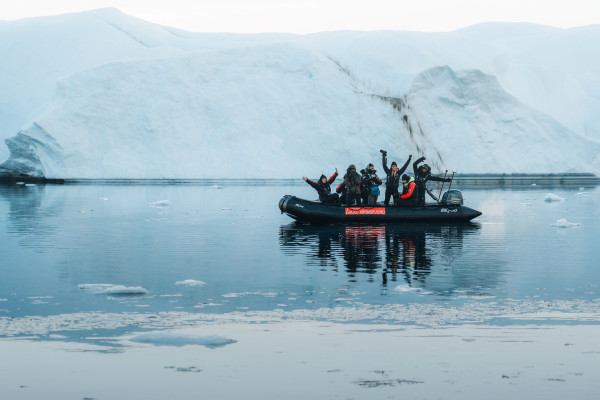
The calving face is the focal point. Standing off in a Zodiac while a glacier sheds a piece of itself into the bay is the sort of moment that goes on the cover of every guest's photo album. The bergs that result, some the size of houses, drift across the cove for days afterwards. Working between them by Zodiac, at the pace the ice allows, is some of the best ice photography on the Peninsula.
The wildlife layers up around the ice. Weddell seals snooze on low-lying floes. Crabeater seals work the edges of the brash. Leopard seals hunt through the cove, sometimes swimming alongside the Zodiacs out of curiosity. Gentoo penguins porpoise through the water. Chinstrap penguins move along the rocky shoreline. Humpback whales and minke whales are common in the surrounding waters during the peak feeding months, and orca and fin whales pass through in the same season.
Then there is the vegetation. Cierva Cove has one of the densest covers of plant life anywhere on the Antarctic Peninsula. The microclimate, the protected aspect, and the surrounding cliffs combine to support bright orange lichens, vivid green mosses, and small patches of Antarctic hairgrass on the rock walls. Most Antarctic landings offer ice, rock, and wildlife. Cierva Cove adds colour.
Across the cove, the orange-red buildings of Base Primavera contrast against the rock and the ice. The Argentine summer station has operated since 1977, expanded from an earlier naval refuge built in 1954. Visitors are not permitted ashore at the base. A Zodiac pass close enough to see it clearly is part of the standard circuit.

South Georgia and Antarctica Shackleton Special Expedition Micro Cruise
54°16’S, 36°30’W
19 days. South Georgia, Elephant Island, and Antarctica in a single voyage. The three places that define the Endurance expedition, followed in sequence. 36 guests aboard Aureum. Spring breathes new life as South Georgia’s vast king penguin colonies teem with activity. Fur seal pups begin to appear, while wandering albatross soar effortlessly overhead.
- 36 guests
- 19 days

Antarctic Peninsula Expedition Micro Cruise by Air & Sea
54°16’S, 36°30’W
Sail the Drake Passage south from Ushuaia, then fly out of Antarctica direct to Patagonia. Four full days on the Peninsula, 36 guests, six senior polar guides, and a farewell night beneath Torres del Paine. The crossing is the point. The flight is the exit.
- 36 guests
- 9 days

Antarctic Circle Expedition Micro Cruise by Air
54°16’S, 36°30’W
Charter flight from Patagonia. Seven full days in Antarctica. A push for the Antarctic Circle at 66°33'S on every departure. Explore pristine ice, wildlife-rich bays, and iconic sites without crowds, and free from rigid schedules with only 36 guests, the first ship of this size in Antarctica.
- 36 guests
- 11 days

Antarctic Circle Christmas Expedition Micro Cruise by Air
54°16’S, 36°30’W
Christmas Day on the Antarctic Peninsula, in perpetual summer light. A charter flight from Puerto Natales, seven full days on the ice, and a push for the Antarctic Circle at 66°33'S.
- 36 guests
- 11 days

Antarctic Circle New Year Expedition Micro Cruise by Air
54°16’S, 36°30’W
Welcome the New Year in Antarctica on a 36-guest Fly & Cruise expedition. New Year's Eve on the Antarctic Peninsula, in light that does not fade. Charter flight from Puerto Natales, seven full days on the ice, a push for the Antarctic Circle at 66°33'S.
- 36 guests
- 11 days
Working the ice and the wildlife from a small ship
Cierva Cove is also one of the few sites on the Peninsula where too much ice can be the access problem, not too little. When the cove is jammed with brash and large bergs from a heavy calving stretch, even Zodiac cruising can be constrained. The site rewards operators who can work the ice rather than try to push through it.
This is exactly where small-ship voyaging earns its keep.
All Zodiacs in the water together, all guests at the ice. With 36 guests on an Expedition Micro Cruise, every guest can be in a Zodiac at the same time, working different parts of the cove. No rotations, no half the ship watching from the deck.
More time at the calving face. Where 200-guest ships have to shuttle visitors in shifts and pull guests back to the ship before the second group launches, our group can stay at the ice for the full window the conditions allow.
Better navigation in heavy ice. A 36-guest deployment can work the available leads between bergs, slow down for a leopard seal, hold position at the glacier face, and reposition without the timing pressure of moving 200 guests through the same morning.
Quiet engines at the calving front. Tier III NOx-filtered engines on our vessels let the ship hold position cleanly when humpbacks are working the bay, without pushing wake into a calving piece of ice.
Naturalist guides on every Zodiac. With a small group, the guides are within speaking distance of every guest, calling species, behaviour, and the geology of the calving face as the morning unfolds.


Common questions about Cierva Cove
Where is Cierva Cove located?
Cierva Cove sits on the west coast of Graham Land, at the far northern end of Hughes Bay, opening into the northern Gerlache Strait. It is around 6 nautical miles southeast of Cape Sterneck. The cove is reached only by ship, on Antarctic Peninsula voyages working the Hughes Bay and northern Gerlache area.
Can you land at Cierva Cove?
No. Cierva Cove sits within a protected Antarctic area, and landings on the peninsula here are not permitted. The site is visited entirely by Zodiac cruise, working the calving face, the icebergs, the seal-bearing floes, and the shoreline near Base Primavera from the water. This is the rule for all operators visiting the cove.
How did Cierva Cove get its name?
The cove was named in 1927 by a British expedition for Juan de la Cierva, the Spanish pilot, engineer, and inventor of the autogyro, the rotorcraft built in 1923 that pioneered the technology behind the modern helicopter. The Antarctic tradition of naming sites for pioneers of exploration, science, and engineering is the reason the place exists on the map under this name.
What wildlife will I see at Cierva Cove?
The headline species are gentoo and chinstrap penguins, with Weddell and crabeater seals on the ice floes. Leopard seals hunt through the cove. Humpback and minke whales work the surrounding waters in the peak feeding months, with orca and fin whales also possible. The cove's calving activity stirs nutrients into the water, which is part of why wildlife concentrates here.
What is Base Primavera?
Base Primavera is an Argentine summer research station on the southwestern shore of Cierva Cove. The station was established in 1977, expanded from an earlier naval refuge built on the same site in 1954. Researchers work the station during the austral summer to study the surrounding wildlife and plant communities. Visitors are not permitted ashore at the base, but the orange-red buildings are visible from the Zodiacs as part of the standard cruise circuit.
When is the best time to visit Cierva Cove?
Antarctic Peninsula voyages reach Cierva Cove during the southern season (late October to March). Mid-December through February typically offers the strongest combination of ice activity at the calving face, whale presence in the surrounding waters, and longer daylight for the Zodiac cruise.
Visit Cierva Cove on a Secret Atlas Expedition Micro Cruise
Cierva Cove rewards small ships. A 36-guest group with every Zodiac in the water at the same time, working the calving face, the icebergs, and the seal-floes for the full morning window, is the kind of polar day that lands differently than a rotation through the same site on a large vessel.
If a voyage to the Antarctic Peninsula and the Hughes Bay area is on your radar, get in touch. The team will walk you through current availability, what the routing involves, and the realistic expectations for Zodiac cruising at sites like Cierva Cove.
Enquire about Antarctic Peninsula Expedition Micro Cruises
See available Antarctica voyages
The Expedition Micro Cruise concept


Other relevant articles

Gentoo Penguins in the Wild | See Them For...
Gentoo Penguins in the Wild | See Them For Yourself

Petermann Island | Where Adélie and Gentoo...
Petermann Island | Where Adélie and Gentoo Worlds Meet

Neko Harbour | Gentoo Penguins & Glaciers ...
Neko Harbour | Gentoo Penguins & Glaciers in Antarctica


Phone
USA
USA+CAN Toll Free
AUS Toll Free
