
King Penguin | Facts, Habitat and Where to See Them in the Wild
Emily has over 15 years’ wildlife experience, with a decade working with gorillas including field research in remote Africa, and supporting conservation initiatives. Since 2017, she guides onboard expedition vessels in the polar regions and works as a Marine Mammal Observer, protecting marine life at sea.

King Penguin
Aptenodytes patagonicus
The second-largest penguin species, known for their striking orange ear patches and upright regal stance, looks dressed ready for a formal occasion. They breed in huge numbers on sub-Antarctic islands, and have the longest, most complex breeding cycle of any penguin. A visit to a king penguin colony is like a party to the senses, the cacophony of vocalisations, the sea of penguins waddling purposefully, and the stark smell of guano in the air. This is one of the most sought-after wildlife encounters on a penguin expedition cruise.

King penguin physical characteristics & size
King penguins are large, slender, and strikingly colourful. They have a distinctive orange-yellow patch on either side of their head, extending toward the chest, and a long, curved black bill with a vibrant orange lower mandible. Their distinct appearance, that of wearing a tuxedo, is a form of camouflage known as countershading. This aids in protection against predators. When viewed from above, their dark backs blend in with the ocean depths, and when viewed from below, their white bellies merge with the sunlit surface waters.
Size: 90 – 100 cm
Weight: 11 – 16 kg
Lifespan: Up to 25 years
Dive Depth: 424.5 m (Max Recorded)


King penguin habitat & distribution
Unlike their closest relative, the emperor penguin, king penguins prefer warmer temperatures. They breed in dense colonies on Sub-Antarctic islands with important populations occurring in South Georgia Island, Macquarie Island, Crozet Island, Heard Island, Marion-Prince Edward Island, Prince Edward Island, the Kerguelen Islands, and the Falkland Islands. They have a preference for flat or gently sloping ice-free areas close to the shoreline with easy access to the sea.
There have been a few observations of king penguins showing up far beyond their usual range, such as in New Zealand. The most recent record was in April 2025 when a king penguin appeared on Pipikaretu Beach along the Otago Peninsula.
King Penguin Cruises & Expeditions
The most immersive way to encounter these remarkable birds is on expedition cruises to see king penguins, particularly in the wildlife-rich islands of South Georgia. Unlike traditional voyages, small ship Antarctic cruises are designed for exploration—allowing you to reach remote beaches where vast king penguin colonies gather in their hundreds of thousands. With expert guides leading each landing, you gain deeper insight into their behavior, breeding cycles, and the fragile ecosystems they inhabit.
A South Georgia penguin expedition offers a level of access and intimacy that larger ships simply can’t match. With fewer guests on board, you’ll spend more time ashore, experience flexible itineraries, and enjoy close—but respectful—wildlife encounters. From stepping onto penguin-filled beaches to observing their interactions just meters away, these expeditions bring you face-to-face with one of the most extraordinary spectacles in the natural world.
King penguin behaviour, breeding & social structure
Breeding
The king penguin breeding cycle is one of the longest and most complex of any bird, lasting 14 to 16 months from courtship to fledging. This unique and complex process sets them apart from other penguin species.


Courtship and pair bonding
Highly social and gregarious, king penguins gather in densely packed colonies that can exceed 200,000 individuals. While they are thought to be serially monogamous, research suggests that only around 30% of pairs reunite the following year. Their courtship displays are both elaborate and captivating, involving synchronised head-swinging, trumpeting calls, and mutual preening rituals that help strengthen pair bonds.
Egg laying and incubation
Unlike most penguin species, king penguins do not build nests. Instead, they lay a single egg that is incubated directly on their feet. Both sexes have a brood pouch, this featherless patch of skin, containing numerous blood vessels that when engaged transfer heat to the egg. The incubation period is approximately 54 to 55 days. Unlike emperor penguins where the male holds the egg both parents alternate the incubation duties for periods of 1 to 2 weeks. One adult will head out to sea and forage whilst the other adult will fast whilst incubating the egg.


Fledging and juvenile years
King penguin chicks develop slowly, remaining in their natal colony for their first year of life, relying on rich regurgitated meals and ongoing parental care until they are ready to fledge. Once they have undergone their first moult and are equipped with waterproof feathers, they head out to sea, usually during the austral spring. Sexual maturity is reached between 3 and 6 years of age. During the first three years, juveniles spend the majority of their time at sea, returning to land only for their annual moult, when they must stay ashore and fast whilst their feathers are replaced.
Chick rearing and crèche formation
Once hatched, the chick is highly vulnerable and will remain on a parent’s feet for up to 40 days until it can regulate its own body temperature. After this critical period the chick joins a crèche; a group of chicks where safety in numbers offers protection from predators and the extreme elements. Huddling together aids in thermoregulation, helping to conserve heat and reduce their energy expenditure.


Breeding frequency and colony activity
Due to their extended reproductive cycle, king penguins typically raise only two chicks every three years. Peak egg-laying is between November and April, however the unique cycle results in active colonies year-round, showcasing different stages of breeding at any given time, from courtship displays and egg incubation to fluffy brown chicks and moulting adults.
King penguin breeding season in South Georgia
King penguins are residents of South Georgia year-round. Their extended breeding cycle means there is always endless activity to observe in the dense colonies.
The best time to see king penguins is during the austral summer from November to March; with peak activity and incredible photo opportunities in December and January.
King penguins are the most spectacular penguins on earth — and South Georgia has the largest colonies.
Salisbury Plain, St. Andrews Bay, Gold Harbour — our expeditions land at all of them. Talk to a specialist about the right month.
Diet and Feeding Habits
King penguins are deep divers, often hunting in the open ocean, sometimes hundreds of kilometres from shore. The king penguin's diet varies seasonally and by location, they consume squid, crustaceans and small fish, but their favoured prey source is the bioluminescent lanternfish.
They are highly efficient, streamlined swimmers, often capturing their prey by ‘pursuit deep diving’, a foraging strategy that involves actively pursuing prey at considerable depths.
A study using time depth recorders revealed that king penguin diving trends correlate with the diel vertical migration of their primary prey, lanternfish. Lanternfish make daily migrations within the water column, ascending toward the surface at night and descending to the ocean depths during the day. The data showed that king penguins adjust their foraging patterns accordingly, diving to depths of over 350 meters during daylight hours, and remaining within 30 meters of the surface at night.

King penguin predators on land & sea
King penguins face a range of predators when at sea and on land.
Predators at sea
In the water they are vulnerable to various species of pinnipeds (seals) including South American sea lions, leopard seals and occasionally Antarctic fur seals. When it comes to cetaceans its mainly orca they need to watch out for, particularly Type B, these ecotypes are known to have a preference for various penguin species on the menu.
Predators on land
On land, they face a range of avian predators including giant petrels, skuas, and even striated caracara when in the Falkland Islands; these birds will opportunistically take eggs and chicks. In addition, they have to deal with the annoyance of the snowy sheathbill, sometimes these little garbage cleaners will try to distract feeding chicks in order to steal freshly regurgitated krill directly from the adults.
Depending on location, southern elephant seals can be potentially dangerous to king penguins. These are the largest seals on the planet, and although they are not looking to prey on the penguins, they pose a threat by accidentally squashing the penguins under their sheer size and motion as they gallumph through the breeding colonies.


Conservation Status
The International Union for Conservation of Nature (IUCN) currently classifies the king penguin as Least Concern. The total population of king penguins is thought to be roughly 2.23 million breeding pairs.
Although the population trend appears to be increasing, the species remains highly vulnerable to climate change, particularly rising ocean temperatures that disrupt prey availability. In some regions, warmer waters have forced adult penguins to forage farther from breeding colonies, leaving chicks unattended for longer periods, leading to higher chick mortality.
Other threats include the occasional entanglement in discarded fishing nets and exposure to oil spills. While there are currently no recorded instances of king penguins caught as bycatch, they may still be susceptible. Notably, Fourteen of the eighteen penguin species have already fallen victim to bycatch.
Where to see them in the wild
South Georgia
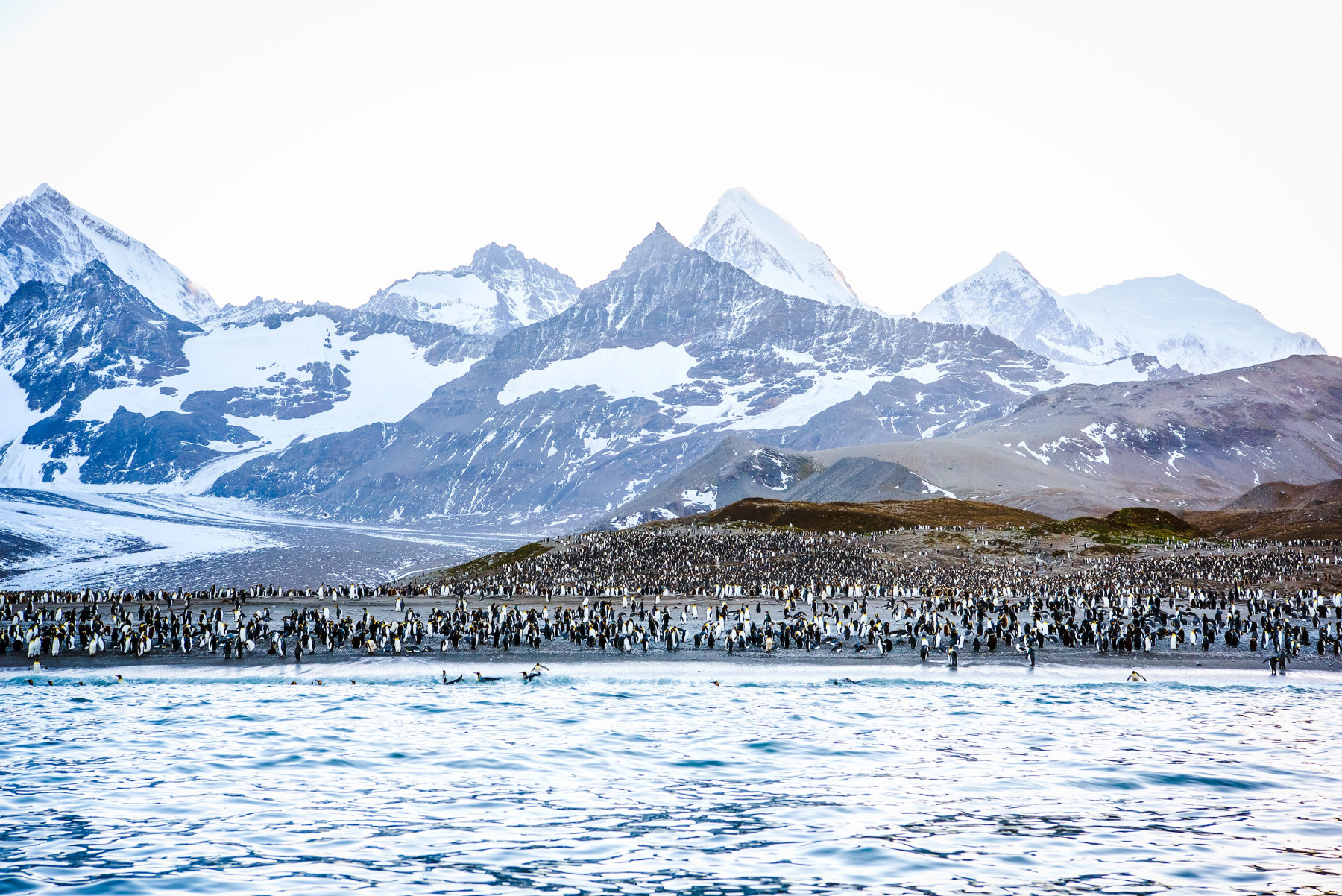
A visit to a king penguin colony in South Georgia is mind blowing. At St. Andrews Bay over half a million king penguins stretch as far as the eye can see, a sensory overload of sound, colour and motion. Salisbury Plain, and Gold Harbour are also popular landing sites hosting dense penguin populations, all featuring dramatic scenery too.

Falkland Islands
Smaller numbers of king penguins can be observed on the Falkland Islands with the largest colony located at Volunteer Point.
Ushuaia, Argentina
If you can’t wait to observe king penguins before embarking on your Secret Atlas expedition, there is a small colony in Ushuaia, Argentina, on Martillo Island. It is a protected area but visits can be made through some local tour operators.
Fun Facts
King penguins are the second largest penguin species, surpassed only by the emperor penguin.
Early explorers mistook the fluffy brown chicks of king penguins for an entirely different species, nicknaming them 'woolly penguins'.
King penguins are impressive swimmers, reaching speeds of up to 7.6 mph (12kph) underwater.
King penguins produce a unique two-voiced call using their syrinx, allowing them to produce two distinct frequencies simultaneously. This remarkable vocalisation helps parents and chicks recognise each other amid the bustling colonies.
The king penguin’s lower mandible is a vibrant orange with UV-reflective properties, which play a key role in attracting mates and social signalling within the colony.
King penguins have a nictitating membrane, a third transparent eyelid that acts like built-in googles, protecting their eyes underwater and from debris.
A recent study revealed that a king penguin reached an impressive depth of 424.5 meters, setting a new record for the deepest dive ever recorded for this species.
FAQs
Do king penguins live in Antarctica?
King penguins do not live on the Antarctic continent itself. Instead, they are found on a
number of sub-Antarctic islands, where ice-free conditions are more suitable for their
breeding and survival.
Where is the largest king penguin colony on earth?
The current population of king penguins on South Georgia is estimated to be 405,425
breeding pairs. The largest colony is located at St. Andrews Bay with an estimated 250,000
breeding pairs.
What do king penguins eat?
King penguins have a diverse diet including squid and crustaceans, however, around 80% of
their diet consists of fish, in particular bioluminescent lanternfish, which they hunt using a
specialised technique known as pursuit deep diving.
What is the difference between the king penguin and the emperor penguin?
Emperor and king penguins are closely related and belong to the genus Aptenodytes. While
they share a similar appearance, emperor penguins are the largest of all penguin species
and are uniquely adapted to breed on the Antarctic ice. In contrast, king penguins nest on
the milder sub-Antarctic islands. Both species feature striking coloration, but king penguins
stand out with their vivid orange markings, particularly around the head and neck.

South Georgia In Depth Expedition Micro Cruise
54°16’S, 36°30’W
15 days devoted entirely to South Georgia. Seven days ashore, early season, before the crowds arrive. Stand among king penguins in their thousands, elephant seals battling, and wandering albatrosses souring above. This is when the island at its most raw. 36 guests aboard Aureum.
- 36 guests
- 15 days

White Kings: South Georgia Special Photo Expedition with Paul Goldstein
54°16’S, 36°30’W
An excitingly ambitious early September foray to South Georgia, with Paul Goldstein. Thirty-six guests. Six senior polar guides maximising every hour of this early season wilderness bonanza.
- 36 guests
- 15 days

South Georgia and Antarctica Shackleton Special Expedition Micro Cruise
54°16’S, 36°30’W
19 days. South Georgia, Elephant Island, and Antarctica in a single voyage. The three places that define the Endurance expedition, followed in sequence. 36 guests aboard Aureum. Spring breathes new life as South Georgia’s vast king penguin colonies teem with activity. Fur seal pups begin to appear, while wandering albatross soar effortlessly overhead.
- 36 guests
- 19 days

Antarctic Peninsula Expedition Micro Cruise by Air & Sea
54°16’S, 36°30’W
Sail the Drake Passage south from Ushuaia, then fly out of Antarctica direct to Patagonia. Four full days on the Peninsula, 36 guests, six senior polar guides, and a farewell night beneath Torres del Paine. The crossing is the point. The flight is the exit.
- 36 guests
- 9 days

Antarctic Circle Expedition Micro Cruise by Air
54°16’S, 36°30’W
Charter flight from Patagonia. Seven full days in Antarctica. A push for the Antarctic Circle at 66°33'S on every departure. Explore pristine ice, wildlife-rich bays, and iconic sites without crowds, and free from rigid schedules with only 36 guests, the first ship of this size in Antarctica.
- 36 guests
- 11 days

Antarctic Circle Christmas Expedition Micro Cruise by Air
54°16’S, 36°30’W
Christmas Day on the Antarctic Peninsula, in perpetual summer light. A charter flight from Puerto Natales, seven full days on the ice, and a push for the Antarctic Circle at 66°33'S.
- 36 guests
- 11 days

Antarctic Circle New Year Expedition Micro Cruise by Air
54°16’S, 36°30’W
Welcome the New Year in Antarctica on a 36-guest Fly & Cruise expedition. New Year's Eve on the Antarctic Peninsula, in light that does not fade. Charter flight from Puerto Natales, seven full days on the ice, a push for the Antarctic Circle at 66°33'S.
- 36 guests
- 11 days

Falklands, South Georgia and Antarctica Micro Cruise
Combine Falklands, South Georgia and Antarctica on a 78-guest cruise expedition in Spring. Follow in Shackleton’s footsteps, witness penguin chicks and whales, and enjoy uncrowded, pristine landscapes.
- 78 guests
- 21 days
Half a million King penguins in one bay. You need to see it to believe it.
Our South Georgia expeditions land at the major King penguin colonies. Book a free call and we'll tell you which departure gets you there in peak season.
The Expedition Micro Cruise concept


Phone
USA
USA+CAN Toll Free
AUS Toll Free
We use cookies to provide a better online experience. Please let us know if you agree to them. You can read our Privacy Policy for more information.

Join the Secret Atlas newsletter
Join the Secret Atlas newsletter
Thank you for signing up!
Welcome to Expedition Micro Cruising. Discover the difference.
We will be exclusively sharing with you our best-kept secrets. You'll receive first-hand expert advice and inspiring stories from our team of explorers, plus our latest news and offers.

Plan Your Journey
Speak to an Expedition Specialist
Every expedition starts with a conversation. Let's discuss your polar adventure dreams and find the perfect journey for you.
Book a Video Call
Speak face-to-face with an expedition specialist. Ask questions, explore ideas, and start shaping a journey built around you.
Book a Phone Call
Talk with an expedition specialist. Get clear, honest guidance to help you plan your next Expedition Micro Cruise.
Download your brochure
Just enter a few details to receive your brochure.