
#47
Researcher Spotlight: Dr. Richard Hann Seeing the Arctic from Above

There are few places on Earth where change unfolds as dramatically…and as suddenly… as it does in the glaciers of Svalbard.
Across this vast Arctic archipelago, rivers of ice spill from mountain plateaus, snake through frozen valleys, and terminate in deep fjords where towering walls of blue ice collapse into the sea. Some glaciers advance steadily for centuries. Others remain quiet until, seemingly without warning, they surge forward with astonishing speed, reshaping entire landscapes in a matter of months.
To most visitors, these glaciers are among the great spectacles of the Arctic.
To Dr. Richard Hann, they are living laboratories.
This August, Secret Atlas is delighted to welcome Richard aboard our Circumnavigation of Svalbard expedition, where guests will have the rare opportunity to travel alongside one of the Arctic's leading specialists in drone-based glacier research. Throughout the voyage, Richard will not only share his discoveries, but will actively conduct research from the ship itself, offering guests a front-row seat to modern polar science in action.
It is a remarkable opportunity to witness how today's scientists are uncovering the hidden processes shaping the rapidly changing High Arctic.

An accidental journey north
Richard's path to becoming a polar researcher was anything but predictable.
Raised in southern Germany, far from glaciers and sea ice, he initially pursued engineering because it seemed practical and dependable. At the time, there was little indication that his future would unfold among some of the most remote icefields on Earth.
Then came a chance encounter with the Arctic.
While studying engineering, Richard spent time in Finland and developed a growing fascination with northern landscapes. One evening, almost on a whim, he applied for a university program in Svalbard after noticing that applications had been extended.
"It was late at night, I was drinking a beer, and I thought, why not?"
The decision changed his life.
The moment he arrived in Svalbard, he felt something shift. The extraordinary light. The vast glaciers. The wilderness. The feeling of standing at the very edge of the inhabited world. "Svalbard touched something in me." That connection has now lasted more than fourteen years.

Today Richard is based in Trondheim, Norway, where he serves as Senior Researcher and Director of the UAV Icing Lab at the Norwegian University of Science and Technology (NTNU). Yet much of his professional life continues to revolve around Svalbard, where he spends months each year conducting fieldwork, teaching university students, and developing new technologies for polar research.

A scientist who flies where others cannot walk
Many of the glaciers Richard studies are among the most dangerous places in the Arctic.
Crevasses can plunge tens of metres into the ice. Surface conditions change constantly. Entire sections of glacier fronts can collapse without warning. Traditional fieldwork often requires researchers to navigate this terrain on foot—a slow, difficult, and sometimes hazardous undertaking.
Richard's solution comes from the sky.
Over the past decade, he has become one of the leading specialists using drones in extreme polar environments. His aircraft fly over heavily crevassed glaciers that would be difficult or impossible to survey safely from the ground. From above, they capture thousands of high-resolution images which are then transformed into astonishingly detailed three-dimensional models of the glacier surface.
What emerges is far more than a photograph.
The resulting maps reveal subtle changes in elevation, movement, melt patterns, fractures, drainage systems, and ice dynamics that would otherwise remain invisible.
"My specialty has become using drones—unmanned aircraft—to fly in cold climate environments."
The technology has opened up new possibilities for Arctic science. Instead of viewing glaciers as static landscapes, researchers can now observe them as dynamic systems constantly responding to forces deep within the ice and beneath the glacier itself.

Solving one of the Arctic's greatest glaciological mysteries
Among Richard's most fascinating research interests are Svalbard's surging glaciers.
Most glaciers move slowly and predictably. Surging glaciers behave differently. For decades they may appear stable. Then suddenly, they accelerate.
Ice that once crept forward a few metres per year can begin advancing hundreds of metres—or even kilometres—over remarkably short periods of time.
Entire glacier fronts can transform within a single season.
Scientists have been studying these events for decades, yet many fundamental questions remain unanswered.
What triggers a surge?
Why do some glaciers surge repeatedly while others never do?
How does a warming climate influence the process?
The answers remain surprisingly elusive.
Today, approximately 36 percent of Svalbard's glaciers are known to display surge behaviour, making the archipelago one of the world's most important natural laboratories for studying the phenomenon.
Richard has become one of the scientists helping to unravel this mystery.
Working alongside international colleagues, he combines satellite observations, drone mapping, field measurements, geophysical surveys, palaeo-glaciology, seismology, and ground-penetrating radar to better understand the complex relationship between ice, water, bedrock, and climate.
His recent work helped contribute to the major Svalbard Integrated Arctic Earth Observing System report: Surging Glaciers in Svalbard: Current Knowledge and Perspectives for Monitoring, which synthesizes the latest scientific understanding of these remarkable glaciers.
The findings highlight both how much has been learned—and how much remains unknown. For Richard, that uncertainty is part of the attraction.


"There are still so many unanswered questions."
— Dr Richard Hann
Seeing glaciers in three dimensions
One of Richard's most exciting areas of research focuses on glacier surface roughness.
At first glance, it sounds like a small detail. In reality, it may have profound implications.
By using drones to create ultra-high-resolution models of glacier surfaces, Richard and his colleagues have discovered that heavily crevassed glaciers interact with the atmosphere very differently from smooth ice.
Crevasses create additional surface area. More surface area means more opportunities for heat exchange with the atmosphere. The result? Glaciers may warm and melt significantly faster than scientists once assumed.

"Depending on the amount of crevasses, it can potentially be more than double the efficiency of heat exchange."
— Richard explains
The implications extend far beyond Svalbard. Improving our understanding of how glaciers respond to warming temperatures helps scientists refine future projections of ice loss, freshwater systems, sea level rise, and Arctic environmental change.
As Richard Hann is quick to note, his work represents just one piece of a much larger scientific puzzle. Yet every piece matters.
Science beyond the lecture hall
What makes travelling with Richard particularly special is that guests aboard our Secret Atlas Expedition Micro Cruises do not simply hear about the science. They become part of the experience.
During our Svalbard Circumnavigation voyage, Richard plans to conduct drone surveys at several remote glaciers that have rarely—if ever—been scientifically mapped using this technology.


"On the circumnavigation trip, we will get this unique opportunity to go to a couple of glaciers that, as far as I know, we would be the first people to scientifically survey with a drone."
Guests will be able to watch drone operations unfold from the ship, learn how the technology works, see the subsequent footage which is quite dramatic, and follow the process from data collection through to final analysis.
Back aboard, Richard will share the results through interactive presentations, detailed 3D reconstructions, and even virtual reality experiences that allow guests to fly across glaciers from a completely new perspective.
Suddenly a glacier becomes more than scenery. It becomes a landscape that can be explored, measured, understood, and appreciated in entirely new ways.
The power of being there
Richard understands that climate change can often feel abstract. Graphs and headlines are easy to ignore. Standing before a glacier hundreds of feet high is something else entirely.
"It's always hard to talk about the effects of climate change when you're sitting in an urban metropolis and don't really get a feeling for the size of the glaciers."
That is one reason he values expedition travel so highly. Guests are not learning about the Arctic through a screen or a textbook. They are standing on deck under the midnight sun. They are listening to glaciers crack and thunder. They are watching Arctic terns wheel overhead while walrus haul out on remote beaches. Most importantly, they are witnessing firsthand one of the most extraordinary environments on Earth.
Richard avoids simplistic narratives of doom and catastrophe. Instead, he encourages curiosity, understanding, and perspective. His goal is not merely to explain climate science. It is to help people develop a deeper connection with the places where these changes are occurring.


Home in the High Arctic
For all his scientific achievements and the fact he is sometimes dropped off with his gear to conduct his studies by a helicopter on the edge of a glacial crevasse, Richard remains remarkably grounded. He spends much of the year writing proposals, analysing data, teaching students, and processing imagery. Like most scientists, only a small percentage of his time is spent in the field. Which is precisely why he treasures every return to Svalbard.
"Svalbard has been like home to me for more than fourteen years."
For Richard, like other scientists, this mysterious archipelago in the High North is a place of memories, friendships, discoveries, and stories. And those stories are something he loves sharing with guests.
His voyages with Secret Atlas have already earned him a loyal following among travellers who appreciate both his expertise and his enthusiasm. Guests quickly discover that behind the sophisticated technology and scientific publications is someone genuinely excited to talk about glaciers, Arctic landscapes, and the extraordinary questions that still remain unanswered.
Join us in the field
The Arctic has always been a place of explorers.
Today, some of the most important exploration is not taking place with sledges and sextants, but with drones, satellite systems, advanced sensors, and scientists willing to venture into some of the planet's most challenging environments.
Dr. Richard Hann represents this new generation of polar exploration. He combines engineering, technology, field science, and storytelling in a way that few researchers can.
— Signe Maria Brunk/Secret Atlas Operations

For guests joining our Circumnavigation of Svalbard Expedition Micro Cruise, the opportunity to travel alongside him offers something genuinely rare: the chance not only to witness the Arctic's glaciers, wildlife, and breathtaking landscapes, but also to understand them through the eyes of a scientist helping to reveal their secrets.
This August, we venture once again north toward the pack ice, polar bears, remote fjords, and some of Svalbard's most spectacular glacier systems. Richard will be there with us—mapping the frozen world from above and sharing its stories from the deck of the ship.
There are still a limited number of spaces available, including one solo cabin and one twin cabin.
For travellers seeking the ultimate Svalbard experience, this voyage offers something truly extraordinary: the Arctic as both adventure and discovery, guided by one of the people helping us understand its future.
Join Richard Hann in Svalbard
Circumnavigation of Svalbard Expedition Micro Cruise
Departure: August 4, 2026
Duration: 12 Days
Guests: Just 12 Travellers
Highlights include:
Travel alongside Arctic drone scientist Dr. Richard Hann
Watch real glacier research conducted in the field
Experience 3D glacier modelling and virtual reality presentations
Search for polar bears along the pack ice edge
Explore remote fjords, bird cliffs, and glacier fronts
Travel with just 12 guests aboard our expedition vessel
Current Availability: 1 Solo Cabin | 1 Twin Cabin
To learn more, contact our expedition specialists.
We hope you will join us as we venture into the High Arctic, where science, exploration, and adventure come together at the edge of the world.

Svalbard Spring Photo Tour
78°13’N, 15°38’E
Landscape photographers adore Svalbard in the early season, when puzzle-piece sea ice and snow-enrobed shorelines glow under pastel sunrises and sunsets.
- 12 guests
- 8 — 10 days

Svalbard Spring Photo Tour with Randy Hanna
78°13’N, 15°38’E
Head north with world-renowned photographer and tutor Randy Hanna, capturing the frozen Arctic landscape of Svalbard in the spring.
- 12 guests
- 10 days
Svalbard Spring Micro Cruise
78°13’N, 15°38’E
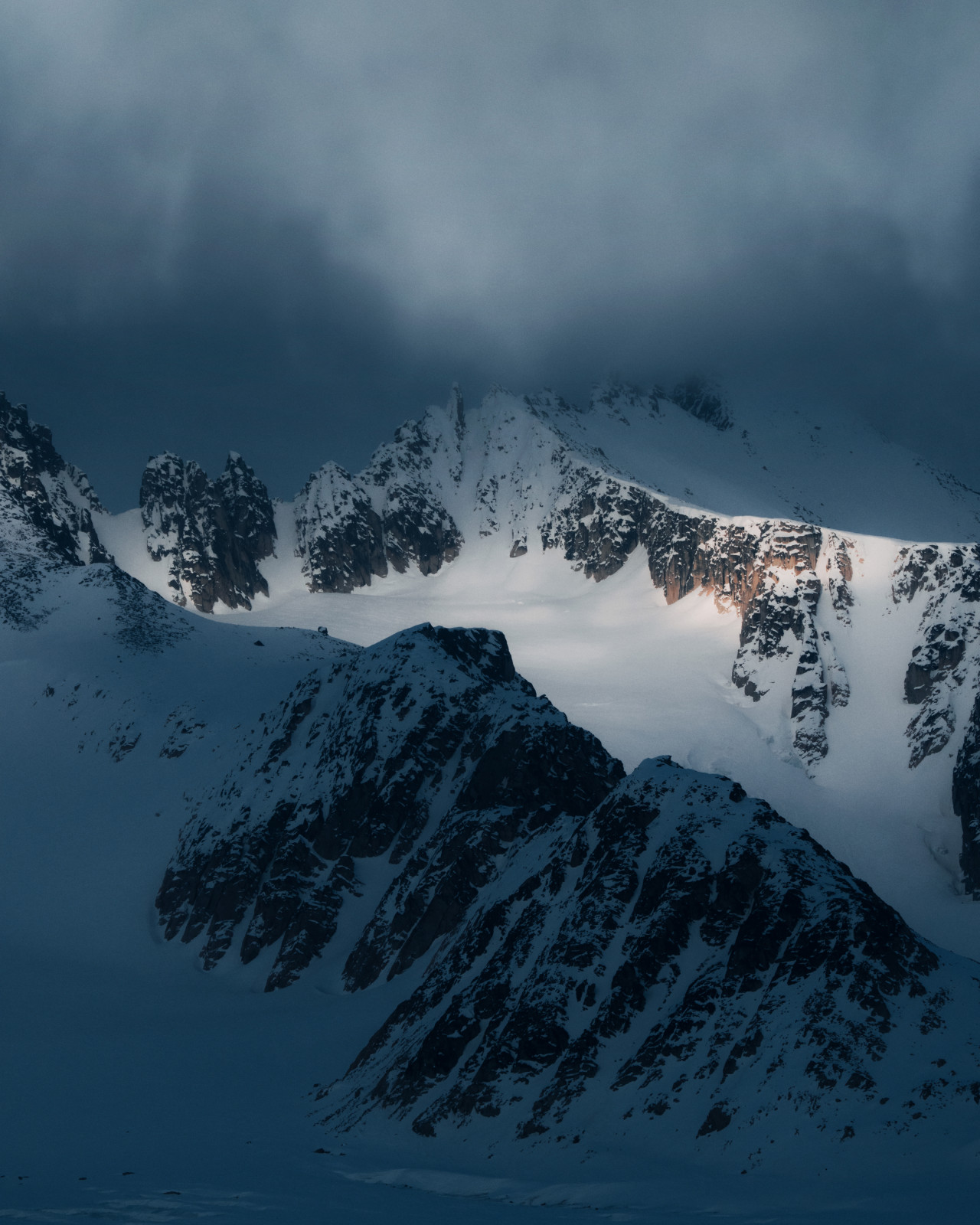
A frozen fairytale of iceberg-strewn fjords, snowy peaks, and puzzle-piece sea ice – as animals take their first steps following winter.
- 12 guests
- 8 — 10 days

Svalbard Summer Micro Cruise
78°13’N, 15°38’E
Set sail in summer, when Svalbard blooms with life, the best time to spot wildlife in Europe’s last great wilderness.
- 12 guests
- 10 days

Svalbard Summer Solstice Micro Cruise
78°13’N, 15°38’E
Our longest photo tour sails when the midnight sun is at its zenith, providing 24-hour photo opportunities in the company of your pro photographer guide.
- 12 guests
- 10 days

Svalbard Summer Photo Tour with Paul Goldstein
78°13’N, 15°38’E
Paul Goldstein is a nature-photography heavyweight, a go-hard, all-hours maestro – and the perfect guide to take your wildlife photography up a gear (or 10) in Svalbard.
- 12 guests
- 10 days

Svalbard Circumnavigation Micro Cruise
78°13’N, 15°38’E
The big one. As the sea opens up under the midnight sun, take the unique opportunity to circumnavigate Svalbard, Europe’s last great wilderness.
- 12 guests
- 12 days

Svalbard Autumn Photo Tour with Virgil Reglioni
78°13’N, 15°38’E
Set off on a late-season adventure, when sunsets and sunrises cast spellbinding colours the archipelago, and capture the meltwater waterfalls of the Austfonna ice cap with top polar photographer Virgil Reglioni.
- 12 guests
- 12 days
The Expedition Micro Cruise concept



Phone
USA
USA+CAN Toll Free
AUS Toll Free
