
#44
The ice doesn't lie: A marine biologist's journey north

Cicely Nagel has spent years working with the ocean. Studying it, researching it, trying to make other people understand why it matters. As Secret Atlas's Marketing and Digital Communications Manager, and a marine biologist by training, she had spent the last year telling the story of Arctic expeditions from a desk.
This spring, she finally got to live one.
She joined MV Freya for Secret Atlas's Spring Svalbard Expedition Micro Cruise. Twelve guests. Seven days. The kind of trip where the schedule is written in pencil, and the ice holds the pen. What she found there stopped her in a way she hadn't quite expected.

"The first thing that hit me was the silence. I knew Svalbard was remote, but reading about it and actually experiencing it for yourself are completely different things. It was a type of silence that seems difficult to comprehend in the world we live in now."
— Cicely
Twelve guests and the right kind of small
Freya carries twelve guests. On the water in Svalbard, that number shapes everything — not as a logistical detail but as a felt experience. The guides briefed real ice conditions each morning, not a pre-planned itinerary. The captain explained his decisions as he made them. When something better presented itself, the ship went there instead.

"It never felt like we were just passengers," Cicely says. "The guides were constantly explaining their decisions — why we were going somewhere, what they were looking for. You felt genuinely involved in the expedition rather than just being there as a guest."
With twelve people on board, the involvement is structural rather than staged. The bridge is open. The briefing is a conversation. And in the evenings, twelve people who had all witnessed the same extraordinary things gathered for dinner while the light outside refused to go away. Simple, but impossible to replicate as the number grows.
Day 2 — Gullybukta: more than just a haul-out
Around thirty large males hauled out on a low beach, draped over one another in that gloriously unbothered way walruses have, their tusks catching the low Arctic light.
For Cicely, this was not simply a wildlife sighting. Atlantic walruses were hunted to the edge of extinction around Svalbard. Centuries of commercial hunting for ivory, oil, and hide had reduced a once-thriving population to near collapse. In 1959, Norway extended full protection to the species. Slowly, the walruses came back. The Svalbard population is now estimated at around 5,000 animals — one of the Arctic's quieter conservation success stories.
Nothing prepares you for how enormous they are in person, and seeing them so healthy, in such good numbers, knowing the history, meant a lot to me.
— Cicely
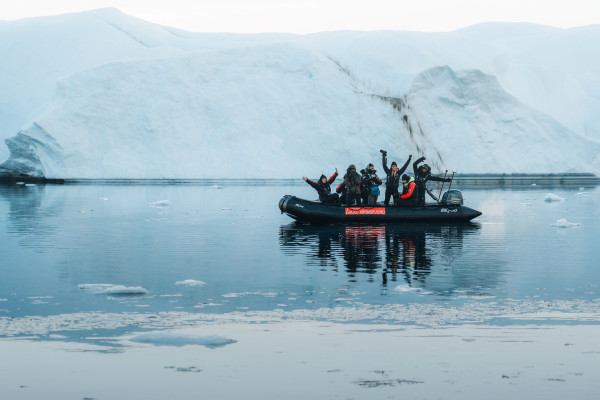
On a larger ship, Cicely would have been one of many watching from a distance. On Freya, she was one of six people in a Zodiac, close enough to hear the breathing, with a guide who knew the population history of every beach on this coastline.

Day 3 — Alkefjellet: reading the ocean through the cliffs
Alkefjellet is the kind of place that makes even seasoned travellers go quiet. Basalt columns rise straight from the water, and in spring every available ledge is packed with Brünnich's guillemots, tens of thousands of them, the noise bouncing off the cliff face and rolling across the fjord. An estimated 60,000 breeding pairs during the summer season. One of the largest seabird colonies in the Arctic.

"Nothing prepares you for the sound," Cicely says.
What struck her, beyond the spectacle, was what the colony was telling her. Brünnich's guillemots are deep divers, capable of reaching 200 metres in pursuit of Arctic cod, a species tightly bound to cold, ice-associated waters. A colony of this size, thriving and returning season after season, is a direct read on the health of the marine system far below the surface. The birds were confirming that the water was still cold enough, still productive enough, the cod still abundant enough to sustain all of that life.
"You spend so much time focused on what is being lost," she says. "Alkefjellet showed us that there are still places where the system is still intact."
Six people in a Zodiac, engines off, drifting below the colony. The sound arrived as a physical thing. Nobody needed to explain why it mattered.
Day 4 — Hinlopen Strait: standing above the food web
When Freya nosed into Hinlopen Strait and the pack ice opened on either side of the hull, the deck went quiet. The world narrowed to white and deep blue. The hull met the ice in low, percussive nudges — a sound you feel as much as hear.
Cicely knew what she was looking at scientifically. As the sea ice melts each spring, it releases cold, nutrient-rich meltwater into the upper ocean. The returning light does the rest.
The result is a phytoplankton bloom of extraordinary intensity, one that can cover thousands of square kilometres and produce more organic matter in a few weeks than some ecosystems manage in an entire year.
Phytoplankton accounts for less than one percent of the total photosynthetic biomass on Earth yet is responsible for almost half of all primary production on the planet. Every animal on the expedition, the walruses at Gullybukta, the guillemots at Alkefjellet, the bear they had not yet seen at Raudfjorden, has its roots in that process. In that ice.
What the Hinlopen passage gave her was something the data had never quite delivered: the physical reality of standing above it.

Day 5 — Lågøya: the luxury of time
Circling Lågøya by Zodiac, a second walrus haul-out came into view. The guides cut the engine and let the boats drift.
No rotation to manage. No group waiting on board. No next stop already decided. The schedule had dissolved into the conditions an hour earlier. This is what twelve guests makes possible — not as a marketing proposition but as a practical fact. Time is given, not rationed.
For Cicely, who had spent years in fieldwork environments where time at a study site is always constrained by budgets and weather windows, it registered as the specific luxury it was.
The walruses remained unhurried. Nobody on the Zodiac was ready to leave. So they stayed.
"You realise quite quickly that the small group really changes what you're able to see, and how long you're able to stay within the moment."
— Cicely
Days 6 and 7 — Raudfjorden and Billefjorden: the bears
The first polar bear came at Raudfjorden in the amber light of a May evening that had no intention of becoming night.
Spotted from the Zodiac, it moved calmly across sea ice alone. The guides held their distance throughout, in line with AECO's wildlife guidelines — close enough to observe properly, far enough to leave the bear's behaviour unchanged. This is what six guests in a Zodiac allows: a sustained encounter rather than a managed sighting. The bear was present to them, and they were present to it, for long enough to understand what they were witnessing.
Polar bears an indicator species, their condition and behaviour reflecting the health of the entire ecosystem beneath them, Cicely explains. A bear like this depends almost entirely on ringed and bearded seals, hunting at breathing holes and haul-out sites during the spring sea ice season, the window in which a bear accumulates up to two-thirds of its yearly caloric intake.

The following day, a second bear appeared, spotted from the deck of Freya moving through Billefjorden. A different animal, a different setting. The same quiet weight.
"I had been in awe of polar bears since I first saw them on a David Attenborough documentary as a child," Cicely says. "Finally seeing one in the wild was one of those moments that will stay with me forever."

What Svalbard gave back
Cicely spends her days at Secret Atlas trying to make people care about places they have never been. She writes about Arctic ecosystems, crafts the content that brings these expeditions to life, and advocates for a part of the world that most of our audience will only ever see through a screen.
Svalbard changed how she does all of that.
There is a difference between describing something and having lived inside it, and that difference shows up in every word you write afterwards. She had read the sea ice data for years, understood the food web, known the population figures. Standing at the bow of Freya in Hinlopen Strait, watching a polar bear cross the ice at Raudfjorden, the numbers became something else. Not abstract. Not distant. Real, and present, and worth fighting for.
Cicely signed off with saying: "The fact that there were only twelve of us onboard made that possible. The silence made it true."



Phone
USA
USA+CAN Toll Free
AUS Toll Free
