
#41
The Twelfth Guest is a Scientist

A Svalbard Expedition Micro Cruise where a marine biologist, an ROV, and twelve explorers shared the same rhythm.
"The ROV came out of a suitcase. Not a metaphor — an actual suitcase, the kind you would check at an airport, opened on the rear deck of MV Freya as the morning light came up over a fjord on the west coast of Spitsbergen. Inside it: a small remotely operated vehicle, cables, a controller, and the working instruments of a marine biology field season.
Dr Paige Maroni unpacked it without ceremony. Tim Macdonald, the subsea engineer who builds and runs the rig, was already tethering out the cable. Twelve guests stood around them on deck, coffee in hand, asking questions. The captain held position. The water was glass. Within twenty minutes the ROV was over the side and dropping beneath the surface of the ice that, for all practical purposes, had never been seen."
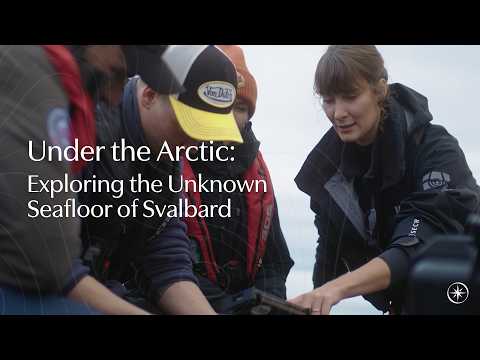
Filmed during research missions in 2025, our film Under the Arctic truly shows what a science research mission looks like aboard a 12-guest Expedition Micro Cruise.
A different kind of voyage
Most expedition operators in the polar regions host scientists the way larger venues host guest lecturers — a presentation in the lounge, a question-and-answer session before dinner, a slot in the daily programme. The scientist visits. The voyage continues around them.
On MV Freya, in July 2024, the relationship was the other way around. Paige and Tim were aboard for the entire expedition, for their research project Polar BLAST, (Baseline, Life, and Structure of the Arctic) a research initiative designed to map Arctic biodiversity and assess ecosystem health. Twelve guests joined for a voyage that had the science built into its rhythm, not bolted onto its evenings. The ROV launched after breakfast on most days. Footage came back to a screen in the lounge. The scientists narrated it live. Conversations carried into dinner and out to the deck again afterwards.
The reason this is possible is structural, and worth saying directly. A 100-guest ship cannot run a daily ROV survey integrated into the voyage rhythm — the logistics make it impossible. A dedicated research vessel can run the science, but there is no one aboard to share it with. Twelve guests on Freya sits in the gap between the two. Small enough to hold position for a dive without a logistics meeting. Slow enough to wait for the right conditions. Stable enough to host the equipment. Social enough that the scientists are at dinner.
What they were actually doing
The Polar BLAST project — Paige’s work, supported by Tim’s engineering — exists because the high Arctic is one of the least understood marine environments on the planet.
The region is warming nearly four times faster than the global average, and commercial fishing is moving into waters that have not yet been mapped, much less understood. The science is a race against the clock.


Daily ROV dives surveyed benthic habitats — the seafloor — and produced 2D and 3D photogrammetric reconstructions of places no one had imaged before.
Baited Remote Underwater Video Stations, or BRUVS, were deployed in the midwater to record amphipods, pteropods, ctenophores: the small drifters that hold polar food webs together.
The team mapped indicator species for Vulnerable Marine Ecosystems, the kind of habitats that international management bodies use to make conservation decisions. They validated species distribution models with real, in-situ observation rather than inference from sea-surface data.
For guests, the result was a different kind of literacy in the polar world. Not just what was visible on the surface — the polar bear on the ice, the beluga in the bay — but what was underneath it. A sea spider moving across rock. A community of cold-water corals. The shape of a fjord floor that had never had a name.
A morning in Hornsund
One morning early in the voyage, the ROV picked up a single sea anemone in close-up — pale, rooted to a stone, fanned open in the slow current. The screen in the lounge showed it for nearly a minute. Guests were watching. Paige said quietly, “We are the first people to see this animal.”
Not the species. This individual. This specific anemone, in this specific bay, on this specific morning. It is the kind of sentence that does not get said often, and it changed the room.
Outside, the sun was on the cliffs of Hornsund. The captain held position. The ROV moved on across the seabed. Guests maintained full engagement.

Join an Expedition Micro Cruise with a difference
Polar BLAST's 2026 fieldwork runs aboard our Northeast Greenland National Park voyage, 10–22 September. Twelve guests. The same ROV. A coastline less surveyed than Svalbard's, and a different set of questions for the seabed.
The exchange runs both ways
Hosting working scientists on a Secret Atlas voyage is not a marketing arrangement. It is a working partnership. For Paige and Tim, the support means access to fieldwork in places that are otherwise prohibitively expensive to reach, on a platform stable enough to operate from. For our guests, it means time with researchers who are doing the work, not summarising it — lectures that become conversations, screen footage that becomes memory, questions that get answered properly because there is time to answer them.
It is also, structurally, what stewardship looks like for an operator at our scale. We talk in the office about responsibility being built into the size of the group, the design of the ships, the regulatory frameworks we choose to operate inside. Hosting Enabling Polar BLAST is part of the same logic. Twelve guest ships can enable this kind of groundbreaking science mission. One hundred cannot. Polar BLAST returns to the Arctic for further fieldwork, building on the 2024 pilot. Some of those days will again be spent aboard Freya, with explorers on deck and an ROV over the side.


What the voyage gives back
In 2024, the work began to surface — papers, footage, data feeding into species distribution models that will, in time, shape how these ecosystems are managed. The guests who were aboard now have a different relationship with the polar world than they did when they left Longyearbyen. They have seen what is underneath it.
That is the quiet argument of an Expedition Micro Cruise. The scale changes what is possible — for the science, for the guests, and for the relationship between the two.
Twelve guests. Two polar guides. One captain. And, when the conditions and the calendar align, a marine biologist with an ROV in a suitcase.
Join the next Polar BLAST voyage.
Paige Maroni will be onboard our Northeast Greenland National Park Micro Cruise, 10th–22nd September 2026.
Speak to an expedition specialist about joining an expedition with purpose.


Phone
USA
USA+CAN Toll Free
AUS Toll Free
We use cookies to provide a better online experience. Please let us know if you agree to them. You can read our Privacy Policy for more information.

Join the Secret Atlas newsletter
Join the Secret Atlas newsletter
Thank you for signing up!
Welcome to Expedition Micro Cruising. Discover the difference.
We will be exclusively sharing with you our best-kept secrets. You'll receive first-hand expert advice and inspiring stories from our team of explorers, plus our latest news and offers.

Plan Your Journey
Speak to an Expedition Specialist
Every expedition starts with a conversation. Let's discuss your polar adventure dreams and find the perfect journey for you.
Book a Video Call
Speak face-to-face with an expedition specialist. Ask questions, explore ideas, and start shaping a journey built around you.
Book a Phone Call
Talk with an expedition specialist. Get clear, honest guidance to help you plan your next Expedition Micro Cruise.
Download your brochure
Just enter a few details to receive your brochure.