
#36
Silence of ice and light: Isaac Afrangui between Greenland and Svalbard

Why Isaac travels north
When Isaac Afrangui first travelled to Antarctica, he did not expect the experience to follow him home.
What stayed with him was not adrenaline or spectacle, but something subtler: a profound quiet. The kind that arrives only when scale replaces noise. Ice instead of clutter. Time instead of urgency.

“I was completely captivated by the icebergs and the starkness of the environment,” Isaac says. “It was so peaceful and quiet. I wanted that experience again. The dramatic landscapes and huge blue bergs made me feel as if I was on another planet.”
So when his emotions began to pull him to return to the polar regions, he did not look for something easier or closer. He looked north—to Greenland.
"It wasn’t about doing something extreme. It was about returning to a feeling I couldn’t find anywhere else."
Choosing a different kind of expedition
Isaac chose to travel with Secret Atlas on an Expedition Micro Cruise aboard Vikingfjord. What appealed to him was not a long list of highlights, but the way the voyage was designed.
A small, capable ship.
A limited number of guests.
An open bridge.
Time to linger.
On paper, the itinerary seemed initially elusive— fjords, glaciers, ice, small settlements. In reality, it became something quieter and more personal.
"It was really very peaceful, just so serene."

Night held in ice
Some of the most lasting moments came after dark.
On some days, clouds closed the sky. Then, without warning, the sky opened. The Northern Lights appeared—slow, deliberate, unmistakable emerald green swathes of undulating light. The way the Northern Lights look in Greenland is unparalleled. The lack of city lights or pollution enhances the great view.
One night, the captain eased Vikingfjord into the sea ice and let her rest there, held gently in place. The ship stopped moving. The world narrowed.
Above them, the aurora burned green.
Guests gathered quietly on deck with cameras and tripods. Isaac had his Nikon with him—but he also reached for something simpler.
“I actually had great luck with my iPhone,” he says. “It was easier than my main camera.”
The lesson was unspoken but clear: when you are in the right place, attention matters more than equipment.

“When the ship stopped in the ice and the Northern lights appeared, it felt like the world had slowed down just enough for us to notice it.”
A ship that allows space
For Isaac, the scale of the voyage mattered as much as the landscape.
“I really liked that Secret Atlas limits the number of guests,” he says. “The crew was wonderful. The bridge was always open.”
With fewer people aboard, landings felt unhurried. There was time to stand still. Time to listen as guides spoke about geology, wildlife, and ice. Our classroom was out in pure nature. There was that blessed time to absorb the feeling of being somewhere truly remote.
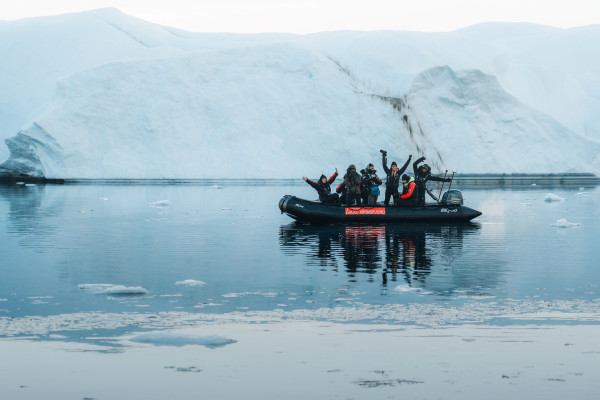
In Zodiacs and on shore, the world felt elemental: pale blue icebergs, amber tundra, jagged peaks, water the colour of polished turquoise.


Meeting the Arctic on its terms
One day, the group went ashore in search of musk ox.
They landed quietly. The tundra opened around them—low, weathered, and still. Eventually, they spotted the animals on a distant slope, dark shapes against the land.
They did not move closer. “They were quite far, and we didn’t want to get any closer”
Instead, he raised his telephoto lens and accepted the distance. The animals remained undisturbed. The moment stayed intact.
“Not everything needs to be approached. Some things are best met with patience.”
Photography as attention
Photography runs through all of Isaac’s journeys—not as performance, but as a way of paying attention.
He travels prepared, but lightly. For Greenland, a Nikon Z6II. For his upcoming expedition, a Z8 and a small, versatile lens set—wide, all-purpose, telephoto. Enough to respond without complication.
He experiments carefully with software, but never pushes an image beyond its truth. His photographs are personal records of ice, light, and presence.

Choosing to go north again
After Greenland, Isaac could have said the experience was enough.
He didn’t.
He has booked another Secret Atlas Expedition Micro Cruise, and this time together with his wife they’ll be heading soon to Svalbard.
The reason is simple. The polar regions offer something increasingly rare: perspective. A sense of being small on a vast planet that does not diminish, but steadies. The kind of clarity that comes from standing in wild places where attention sharpens and the world feels honest.
Travelling here carries excitement. Awareness. A quiet edge that reminds you you’re alive—whether stepping ashore with experienced guides nearby, or simply standing on tundra knowing you are part of something much larger.
“The polar regions don’t make you feel smaller. They make you feel placed.”
Looking ahead
Isaac prepares carefully. He plans. He chooses what to carry and what to leave behind. He moves forward with intention.
His journeys are not to escape, but a return—to places where time loosens its grip, the mind grows quiet, and the world feels wide enough to hold everything you bring with you.
In Greenland, under ice and light, he found that again.
In Svalbard, he is ready to look for it once more.
Discover our Expedition Micro Cruises to Greenland and Svalbard
Other relevant articles

#13 Annie’s Svalbard Expedition: A Life-Changi...
Annie’s Svalbard Expedition: A Life-Changing Arctic Micro Cruise

#2 25 Best Places to Visit in Norway
25 Best Places to Visit in Norway

#6 From the Frontlines to the Arctic: Meet Jo...
From the Frontlines to the Arctic: Meet John Rodsted and Mette Eliseussen


Phone
USA
USA+CAN Toll Free
AUS Toll Free
