
#45
Small Ships vs Big Ships: What I Learned on a Secret Atlas Micro-Cruise

When people think about expedition cruising in the polar regions, they often imagine dramatic glaciers, unique wildlife, and remote landscapes. What many don't realise is that the size of your ship can fundamentally shape how you experience all of those things.
Recently, I joined one of Secret Atlas' expedition micro-cruises to Svalbard as part of a familiarisation trip. The goal was simple: experience firsthand what our guests experience so I could better support future travellers and bring authentic knowledge back to our team.
Having previously visited the Arctic and Antarctica on ships of 100+ guests, I was interested to see how my experience would differ.
Both large and small expedition ships have their place, but what struck me throughout the voyage was how consistently the small-ship experience enhanced three things that matter most in the polar regions: the onboard experience, the expedition experience and the impact.

The Onboard Experience: Personal Rather Than Anonymous
One of the first things I noticed was how quickly a group of strangers became a community.
With only 12 guests onboard, everyone knew each other's names by the end of the first day. As a solo traveller, I found this particularly valuable. There was never any sense of being lost in a crowd. Conversations carried from meals to excursions, and shared experiences quickly created connections.
The guides were equally accessible. I joined a photography tour and by the end of the first day, our guides already knew which cameras each guest used, their photography experience and their goals for this trip. During one photography workshop, our photography guide used live examples from images guests had taken earlier in the voyage, making the session feel genuinely personalised.
Throughout the trip, it was easy to ask questions, share observations, or continue discussions from previous landings.

Another feature I particularly loved was the open bridge policy. In fact, the bridge became one of the most popular gathering spaces onboard. Guests could watch the captain at work, ask questions, search for wildlife and feel in the heart of the expedition operations. Wildlife sightings often triggered a quick call to the bridge, and thanks to the small ship size, within moments everyone could be there watching events unfold.
On larger ships, expedition teams work incredibly hard to engage with guests, but naturally they must divide their attention across many more people. On Freya, the small scale created opportunities for informal conversations and spontaneous learning that became some of the most memorable parts of the voyage.

The Expedition Experience: Access, Flexibility and Time
The most significant differences emerged once we left the ship.
Small expedition ships have practical advantages in Arctic waters. They can navigate narrower channels, access smaller anchorages, and adapt quickly to changing conditions. During our voyage, this flexibility repeatedly translated into richer experiences ashore and on the water.
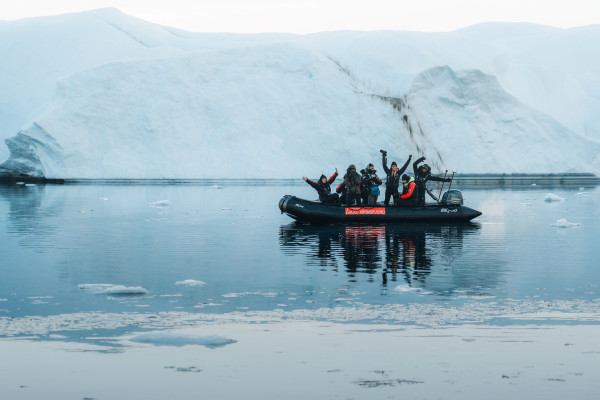
One of my favourite moments came during a zodiac cruise among ice floes in front of Smeerenbergbreen glacier. The water was completely calm. With the engines switched off, our zodiac drifted silently among floating ice. We could hear only the gentle crackling and popping of the ice around us. The reflections were so perfect that the fjord appeared almost indistinguishable from the sky.

During another outing, curious walruses approached our zodiac, surfacing first on one side of the zodiac and then the other. With only six guests per zodiac, everyone had room to move, observe, and photograph comfortably. Wildlife encounters became more dynamic because there was space for everyone to respond naturally to what was happening around us.
Later in the voyage, we landed at Gullybukta and spent nearly two hours observing a walrus colony ashore. The extended time allowed us to appreciate subtle behaviours and simply enjoy being present in the environment. During our visit, several larger ships passed by offshore. Watching that contrast reinforced how valuable flexibility and time can be when experiencing wildlife.
Sustainability: Small Scale, Thoughtful Impact
One of the great things I noticed aboard the MV Freya was how naturally sustainability was woven into daily life.
With just 12 guests onboard, every aspect of the operation felt intentional. Meals were thoughtfully planned, portions were carefully considered, and food waste was minimised. Rather than offering endless buffet choices, the chef focused on preparing excellent meals using local ingredients where possible and creatively incorporating leftovers into future dishes.
I particularly enjoyed the Swedish tradition of fika—fresh baking, tea and coffee served between excursions. The rhythm of breakfast, fika, lunch, fika and dinner kept us well fuelled for active expedition days without creating unnecessary excess.
The small-group format also shaped our wildlife encounters in what felt a sustainable way. Whilst we want to visit and enjoy these beautiful regions, we do understand their fragility and we always want to conduct our expeditions with sustainability and respect at the forefront. With only 12 guests observing animals, viewing felt calm and respectful. There was no need to compete for space or viewing positions, or 10 zodiacs approaching one animal. Instead, everyone had an opportunity to watch quietly while wildlife behaved naturally.

Why Small Ships Won Me Over
Before I travelled to Svalbard, I understood the operational case for small expedition ships. After travelling on one, I understood something different.

On a large expedition ship, the day is managed from the inside out. Rotations. Sequences. Groups waiting on board while others are ashore. The encounter belongs to the schedule.
On an Expedition Micro Cruise, it runs the other way. Twelve guests means all twelve are ashore in one go. When the walruses surfaced alongside the Zodiac — first one side, then the other — there was no group to recall, no rotation to maintain. We stayed until the encounter was finished. The animals decided when it was over.
That is not a small operational detail. It is the whole difference.
I came home with photographs. More usefully, I came home certain of something I had only understood abstractly before: the small ship is not a compromise on the large ship experience. It is a different experience entirely — one the polar regions specifically reward.
The Arctic does not scale. The silence at Smeerenbergbreen, the walrus colony, the bear that did not change course because six people in a Zodiac were too few to register — these moments exist at twelve guests. They do not exist at two hundred.
The number twelve is not incidental. It is the whole answer.

Other relevant articles

#8 The Expedition That Founded Secret Atlas
The Expedition That Founded Secret Atlas

#13 Annie’s Svalbard Expedition: A Life-Changi...
Annie’s Svalbard Expedition: A Life-Changing Arctic Micro Cruise

#9 A Day in the Life of an Expedition Micro C...
A Day in the Life of an Expedition Micro Cruise to Svalbard


Phone
USA
USA+CAN Toll Free
AUS Toll Free
